Every figure checked against its source on 5 November 2026
Planning permission for air conditioning: when you need it
Not for a reversible unit on a house that meets every permitted development condition. You will need it for a cooling-only unit, a flat above a shop, a listed building, a road-facing wall in a conservation area, or a street covered by an Article 4 direction. This guide covers England and points out where Croydon differs.
Ask for a quote
Name, number and postcode. We ring you to go through it.
What are the permitted development conditions?
| Condition | House | Block of flats |
|---|---|---|
| Not used solely for cooling | Yes | Yes |
| Installed to MCS 020a | Yes | Yes |
| Outdoor unit volume | Up to 1.5 cubic metres | Up to 0.6 cubic metres |
| How many units | The first, or the first two on a detached house | The first on the block, which must be wholly flats |
| Pitched roof | Not permitted | Not permitted |
| Flat roof | Allowed, one metre or more in from the edge | Allowed, one metre or more in from the edge |
The unit must also be sited, so far as practicable, to limit its effect on the look of the building and the area, and removed as soon as reasonably practicable once it is no longer needed for heating. From 28 May 2026 the Planning Portal names MCS 020a as the only scheme that counts. Source: Planning Portal.
Why does "reversible" matter so much?
Because the rights were written for heat pumps, not coolers. On 29 May 2025 the rules were widened so that air-to-air heat pumps could use them, with the volume limit raised to 1.5 cubic metres on a house and the old one-metre boundary rule dropped. The Planning Portal's condition remains that the unit is not used solely for cooling. A cooling-only system therefore has no permitted development route at all, and the honest advice is to expect to apply. Sources: MCS; Planning Portal.
What changes inside a conservation area?
The unit cannot go on a wall or roof that fronts a highway, or anywhere nearer to that highway than the building itself. That rules out the front wall, the front roof slope and the front garden.
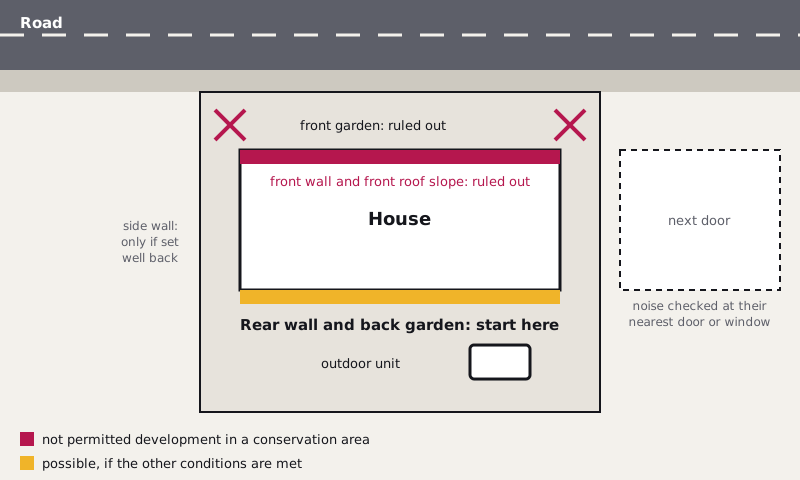
Croydon has 21 conservation areas, listed in the Local Plan as Addington Village, Beulah Hill, Bradmore Green, Central Croydon, Croham Manor Road, Croydon Minster, Chatsworth Road, Church Road in Upper Norwood, Church Street, East India Estate, Harold Road, Kenley Aerodrome, Norbury Estate, Norwood Grove, South Norwood, St Bernard's, The Waldrons, The Webb Estate, Upper Woodcote Village, Upper Norwood Triangle and Wellesley Road North. Outside a conservation area the only wall rule is that a unit cannot go above ground-floor level on a wall fronting a highway. Sources: Planning Portal; Croydon Local Plan.
Why does a flat above a shop need an application?
Because the rights for flats only cover a building that consists wholly of flats. A block with a shop, café or office on the ground floor is outside them, however small the unit. The 2021 Census counted 2,238 Croydon households living in commercial buildings, mostly above shops on the borough's parades, and every one of them should expect to apply, after getting the freeholder's agreement. The flats guide has the rest. Sources: Planning Portal; Census 2021.
What is the noise test?
MCS 020a, which works out the sound level at an assessment position next to the nearest door or window of the neighbouring building. If the calculated level is 37 dB(A) or less, the installation passes that condition. Distance, barriers and the model chosen all feed into the sum, and a quiet unit placed badly can fail where a louder one placed well passes. Ask to see the calculation for your own house. Sources: Grant UK; Planning Portal.
What is an Article 4 direction, and does Croydon have any?
A council order that removes particular permitted development rights in a particular place. Croydon Council has them in the Chatsworth Road, The Waldrons and Kenley Aerodrome conservation areas, plus a borough-wide one, in force since 28 January 2020, that makes turning a house into a small shared house a matter for planning permission. A condition on the original permission for a newer home can do the same job. None of these show up on a quick look at the house, so check with the council before relying on permitted development. Sources: Croydon Council on conservation areas; Croydon Council on HMOs; Planning Portal.
What about businesses and listed buildings?
A business should expect to apply: the Planning Portal's advice for non-domestic land is that an air source heat pump will probably need planning permission. A listed building gets no permitted development within its grounds and needs listed building consent for any work affecting its character, inside or out. Doing it without consent is an offence carrying up to two years in prison on indictment. Historic England said in 2023 that heat pumps are generally acceptable on listed buildings when sympathetically sited, so the answer is often yes, but only after the application. Sources: Planning Portal; Listed Buildings Act, section 7; section 9; The Construction Index.
Questions people ask
What if I fit one and it turns out I needed permission?
The council can serve an enforcement notice requiring the unit to be moved or removed, and ignoring the notice is a criminal offence. Checking first is cheaper.
Can I get it in writing that I did not need permission?
Yes, by applying for a lawful development certificate. It is worth having when you sell.
Do these rules apply in Scotland or Wales?
No. This guide is England only.
Where these facts come from
- Planning Portal: heat pumps on houses and flats, permitted development
- MCS: the permitted development changes of May 2025
- Croydon Local Plan 2018: appendix 5, conservation areas and local heritage areas
- Census 2021: accommodation type in Croydon
- Grant UK: heat pump planning guide for England, including the 37dB(A) test
- Croydon Council: conservation areas
- Croydon Council: Article 4 direction on small HMO conversions
- Planning Portal: heat pumps on business premises
- Listed Buildings Act 1990: section 7, on legislation.gov.uk
- Listed Buildings Act 1990: section 9, on legislation.gov.uk
- The Construction Index: Historic England's view on heat pumps and listed buildings (2023)
- Mishcon de Reya: keeping cool, the legal checks before fitting air conditioning (July 2026)
Useful to have ready
With these we can give you a straight answer on the first call.
- Your postcode
- Flat, house or business premises
- Who owns the outside wall, if you lease or rent
- Which room, roughly how big, and which way the window faces
- Any conservation area or listing you know of
Ready to go ahead? Air conditioning in Croydon covers what we fit, what we look after and where we travel.
Ready to have it fitted?
Air conditioning installation
A survey, a written price, then units, pipework and electrics fitted properly.
Air-to-air heat pumps
Cheaper warmth than a plug-in heater, and cooling from the same box.
Multi-split air conditioning
Two to four rooms from one outdoor unit, each on its own controller.
More guides
How much does air conditioning cost?
Unit prices, labour, electrics, running costs and the extras flats add.
Can you have air conditioning without an outdoor unit?
Monobloc units explained: what they do well, where they fall short.
Air conditioning in a flat: who has to say yes?
Leases, freeholder charges, the one-unit-per-block rule and office conversions.
Is bedroom air conditioning worth the money?
The 26°C rule, what to try first, fixed or portable, and what a night costs.
Cooling a loft conversion: what actually works?
Why lofts overheat, what Part O misses, and where the units go.
Which size of air conditioner is right for the room?
A room size table, the adjustments that matter, and why bigger is not better.
Checking an installer on the F-gas register
Company certificates, personal qualifications, and who issues them.
Portable or fixed: which air conditioning should you buy?
A fair comparison, including when the portable wins.
Prefer a call back?
Leave your postcode and a line about the room, and we ring you. Or ring 020 8194 3009.