Air conditioning for Croydon flats, houses and workplaces
We install, service and repair air conditioning across Croydon, from top-floor flats in the town centre to semis in Shirley and shops on the parades. Nearly everything we fit runs in reverse, so the unit that cools a bedroom in August can heat it in February. Send a postcode and we call you back.
Ask for a quote
Name, number and postcode. We ring you to go through it.
- Survey before any price
- Freeholders and leases dealt with
- Heats as well as cools
How warm does Croydon get, month by month?
Each tower is one month's average daytime high at Kenley Airfield, the Met Office climate station in the south of the borough. Lit windows mark the months a reversible unit mostly cools; dark ones the months it mostly heats.
- 7 degrees, typical daytime high, a heating monthJanuary
- 7 degrees, typical daytime high, a heating monthFebruary
- 10 degrees, typical daytime high, a heating monthMarch
- 13 degrees, typical daytime high, a heating monthApril
- 17 degrees, typical daytime highMay
- 20 degrees, typical daytime high, a cooling monthJune
- 22 degrees, typical daytime high, a cooling monthJuly
- 21 degrees, typical daytime high, a cooling monthAugust
- 18 degrees, typical daytime highSeptember
- 14 degrees, typical daytime high, a heating monthOctober
- 10 degrees, typical daytime high, a heating monthNovember
- 8 degrees, typical daytime high, a heating monthDecember
Mean daily maximum in °C, 1991 to 2020. Kenley sits up on the Downs and averages about 35 days of air frost a year; the town centre runs warmer, and a heatwave runs far above these averages. On the night of 18 July 2022 the same station never dropped below 25.8°C. Sources: Met Office; Met Office on July 2022.
Why is cooling a Croydon home mostly a question about walls?
Because so few Croydon households own the wall the unit goes on. At the 2021 Census the borough had 152,946 households, and 60,674 of them, four in ten, lived in flats: 44,285 in purpose-built blocks, 12,973 in houses carved up into flats, 2,238 above shops and in other commercial buildings, and the rest in converted schools, churches and the like. Another 35,580 lived in terraces, where the outside wall is yours but the garden is six metres from the neighbour's bedroom.
A flat means the freeholder decides, under the terms of the lease, and the planning rules allow a single outdoor unit on a block of flats. A terrace or a semi gets one outdoor unit as permitted development. A detached house, which only 12.2% of households have, gets two. So the first thing we ask is not how big the room is but who owns the outside of it, and the guide for flats and the planning guide start there too. Sources: Census 2021; Planning Portal.
What about the flats that used to be offices?
They are the hardest homes in the borough to keep cool, and there are a lot of them. From May 2013 developers could turn offices into flats without full planning permission. By October 2014 Croydon had approved 1,236 such units, 1,168 of them studios or one- and two-bed flats and 1,074 below the London Plan's space standards, and the council brought in an Article 4 direction from 10 September 2015 to stop the flow in the town centre. That direction has since lapsed. Around a thousand flats now sit in converted office blocks in the centre, and in 2024 the owner of No1 Croydon, the 24-storey tower beside East Croydon station, gave notice of 250 more.
Research for the government in 2020 found that only 22.1% of homes created this way met the national space standard and 72% had windows on one side only, against 29% of homes built with planning permission. Single-aspect, sealed-glazed rooms with no cross-ventilation are exactly what air conditioning was invented for, but the building's rules decide what can be fitted. For many of these flats the answer is a unit with no outdoor box. Sources: Pinsent Masons; Inside Croydon; UCL.
Where can an outdoor unit go in one of Croydon's conservation areas?
Not on the road side. Croydon Council has 21 conservation areas, from Central Croydon, designated in November 1982 around the historic municipal and commercial heart, to Norwood Grove, The Webb Estate in Purley, Bradmore Green in Old Coulsdon and Kenley Aerodrome. Inside any of them, the permitted development rules exclude a wall or roof that fronts a highway and any position nearer to the road than the building, so the search begins at the back. Three of the areas, Chatsworth Road, The Waldrons and Kenley Aerodrome, also carry Article 4 directions that remove further rights.
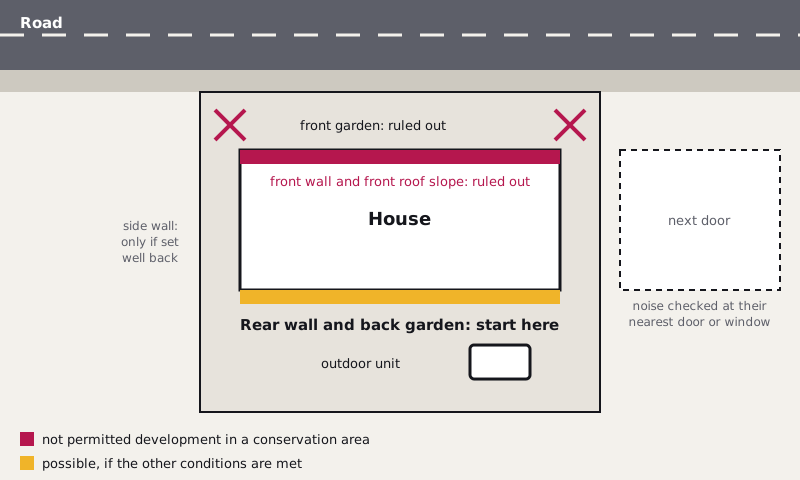
Outside a conservation area, the only wall rule is that a unit cannot sit above ground-floor level on a wall facing a road. Sources: Croydon Council; Croydon Council on Central Croydon; Planning Portal.
Why are more Croydon households asking about cooling now?
Because the summers have changed. The Met Office confirmed 2026 as the UK's hottest summer on record, with a mean of 16.5°C and a peak of 38.1°C at Kew on 13 August, beating the 16.1°C set only the year before. Nights are the problem in a town of flats. On 18 July 2022 the Met Office station at Kenley, in this borough, recorded a minimum of 25.8°C, which stood as the warmest night in British records until a 26.8°C reading from Oxfordshire was verified a month later.
Government research treats 26°C as the point at which a bedroom stops delivering a good night's sleep, and found over half of households sometimes feel unable to open their windows, mostly because of noise or security. In a flat on Wellesley Road or a terrace on the Brighton Road, that is most nights. Our home air conditioning page starts with the bedroom, and the bedroom guide compares the options. Sources: ITV News, reporting the Met Office; Met Office; MHCLG research.
Houses and flats
Start with the room that defeats you in July. In Croydon that is usually a top-floor flat, a back bedroom with the afternoon sun on it, a loft conversion, or a conservatory that nobody sits in after lunch.
Air conditioning installation
A survey, a written price, then units, pipework and electrics fitted properly.
Home air conditioning
Bedrooms, top-floor flats and loft rooms, with heating thrown in.
Air-to-air heat pumps
Cheaper warmth than a plug-in heater, and cooling from the same box.
Multi-split air conditioning
Two to four rooms from one outdoor unit, each on its own controller.
Conservatory air conditioning
Turns a glass room you use in May into one you use in August and January.
Offices, shops and restaurants
A third of the borough's 126,000 jobs are in the town centre, in offices that were built for typewriters and now hold screens. Add the shops, cafés and salons on every parade from Norbury to Purley, and a lot of rooms in Croydon run hot for a living.
Servicing and repairs
Already have a system? We look after units whoever fitted them. Still deciding? Start with what air conditioning costs.
How does a cooling unit heat the room in winter?
By running the refrigerant the other way. In heating mode the outdoor unit collects heat from the air outside, even on a frosty morning, and the indoor unit releases it into the room. The Energy Saving Trust puts the seasonal efficiency of air-to-air heating at typically above 4, so one kilowatt-hour of electricity becomes four of warmth. On Ofgem's October to December 2026 cap of 26.32p per kWh, that is about 6.6p for a kilowatt-hour of heat, against 26.32p from a plug-in heater and 7.97p for gas before boiler losses.
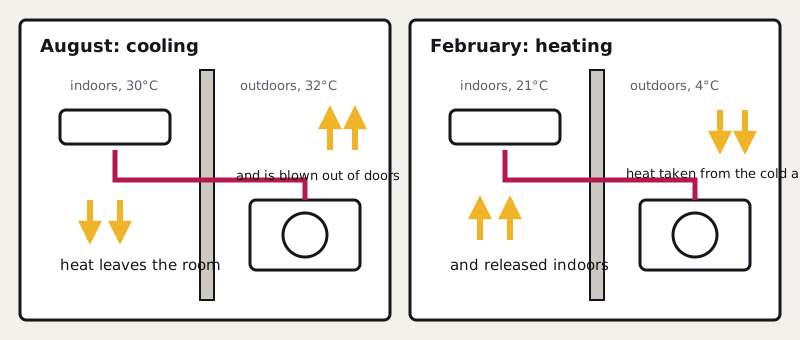
It heats the air in the room it serves, not the radiators or the hot water, so the boiler stays. The clearest winners are the thousands of Croydon flats with electric heating and no gas. See air-to-air heat pumps. Sources: Energy Saving Trust; Ofgem.
What does cooling a Croydon office or shop involve?
Numbers first. The Greater London Authority counts 126,000 jobs in the borough in 2023, a third of them in the Croydon Opportunity Area around East Croydon and the town centre, which the London Plan has pencilled in for 14,500 homes and at least 10,000 more jobs. Most of the office floors are 1960s and 1970s buildings with deep plans and big glass, and most of the shops have flats above them.
The law asks only for a reasonable temperature in an indoor workplace, with no maximum written down, but the Health and Safety Executive said in June 2026 that heat is a hazard to be assessed like any other. Larger systems carry a second obligation: once the total passes 12kW, an energy inspection is due at least every five years. See office air conditioning, shops, cafés and restaurants and server room cooling. Sources: GLA; Regulation 7; HSE press office; GOV.UK guidance.
What should you check before paying any installer?
Three pieces of paper. First, the company's F-gas certificate: any business working on other people's systems, sole traders included, must be certified by one of three approved bodies and renew every three years, and the engineer who handles the refrigerant needs a personal qualification as well. Second, who signs the electrical certificate, because a new circuit in a home is notifiable under Part P and must come from a registered competent person. Third, the noise calculation at your neighbour's nearest window, which decides whether the job is permitted development at all.
Ask us for all three. Then check what we tell you by following the F-gas guide. Sources: GOV.UK on companies; GOV.UK on qualifications; IET on Part P; Grant UK.
Where do we work?
Croydon first, then the towns on its borders. Each page below sets out what is particular about that place: its housing, its council's rules and where the outdoor unit can go.
Air conditioning in Bromley
Air conditioning in Sutton
Air conditioning in Mitcham
Air conditioning in Streatham
Air conditioning in Beckenham
Air conditioning in Coulsdon
Air conditioning in Banstead
Air conditioning in Sydenham
The rest of our patch
- Croydon town centre, Old Town, Waddon and Broad Green (CR0, CR9)
- Addiscombe, Woodside and Shirley (CR0)
- New Addington, Forestdale and Addington Village (CR0)
- South Croydon, Sanderstead and Selsdon (CR2)
- Purley and Kenley (CR8)
- Thornton Heath and Norbury (CR7, SW16)
- South Norwood, Upper Norwood and Crystal Palace (SE25, SE19)
- Wallington and Carshalton (SM5, SM6)
- West Wickham, Penge and Anerley (BR4, SE20)
- Caterham, Whyteleafe and Warlingham (CR3, CR6)
What happens next?
You tell us about the room
Ring 020 8194 3009 or send the form with a postcode, and say which room runs hot, and whether you own the outside wall.
We survey the building
We measure the room, find a place for the outdoor unit, check the electrics and ask about the lease or the freeholder. You get a written price with the electrics itemised.
Consents come first
If a freeholder, a landlord or the council has to agree, that happens before anything is drilled. We supply the drawings and the sound figures they ask for.
We fit, test and show you the controls
Units, pipework and the new circuit go in, the system is pressure tested, evacuated and charged, and you leave with the certificates. A yearly service keeps it right.
Guides worth a look first
How much does air conditioning cost?
Unit prices, labour, electrics, running costs and the extras flats add.
Planning permission for air conditioning: when you need it
The permitted development conditions, with Croydon's exceptions.
Can you have air conditioning without an outdoor unit?
Monobloc units explained: what they do well, where they fall short.
Air conditioning in a flat: who has to say yes?
Leases, freeholder charges, the one-unit-per-block rule and office conversions.
Is bedroom air conditioning worth the money?
The 26°C rule, what to try first, fixed or portable, and what a night costs.
Cooling a loft conversion: what actually works?
Why lofts overheat, what Part O misses, and where the units go.
Which size of air conditioner is right for the room?
A room size table, the adjustments that matter, and why bigger is not better.
Checking an installer on the F-gas register
Company certificates, personal qualifications, and who issues them.
Portable or fixed: which air conditioning should you buy?
A fair comparison, including when the portable wins.
Questions we get from Croydon
What does it cost to fit air conditioning in Croydon?
We price after a survey. As a national yardstick, Checkatrade gives £750 for a 12,000 BTU wall unit plus £1,150 to fit it, about £1,900 together, with electrics adding £400 to £700. A licence to alter on a flat adds the freeholder's costs. See the cost guide.
I live in a flat. Can I have it at all?
Usually, once the freeholder agrees in writing. Planning allows one outdoor unit per block, so if a neighbour already has one you will need an application. If the freeholder says no to any outdoor unit, a monobloc with two wall grilles is the fallback.
My flat is in a converted office block. Is that different?
Yes, in two ways: the building usually has no balcony or garden to put an outdoor unit on, and the management company's rules are strict. We look at the elevation and the rules before quoting.
Can a unit go on the front of my house?
Not under permitted development in a conservation area, and not above ground-floor level on a road-facing wall anywhere. The rear is the first place we look.
Will it heat the room too?
A reversible unit will, and at about a quarter of the cost of a plug-in heater. It does not run radiators or make hot water, so the boiler stays.
Which places do you cover?
The whole borough of Croydon, plus Bromley, Beckenham, Sutton, Mitcham, Streatham and the towns between. The full list is on our areas page.
Prefer a call back?
Leave your postcode and a line about the room, and we ring you. Or ring 020 8194 3009.